Amazon Product Photography With a Phone
A modern phone can shoot a compliant Amazon main image. It cannot fix your lighting, your background or your angle — and those are what actually go wrong.
Updated September 1, 2026. Updated with the current main-image requirements and a note on why phone shots fail specifically at thumbnail size.
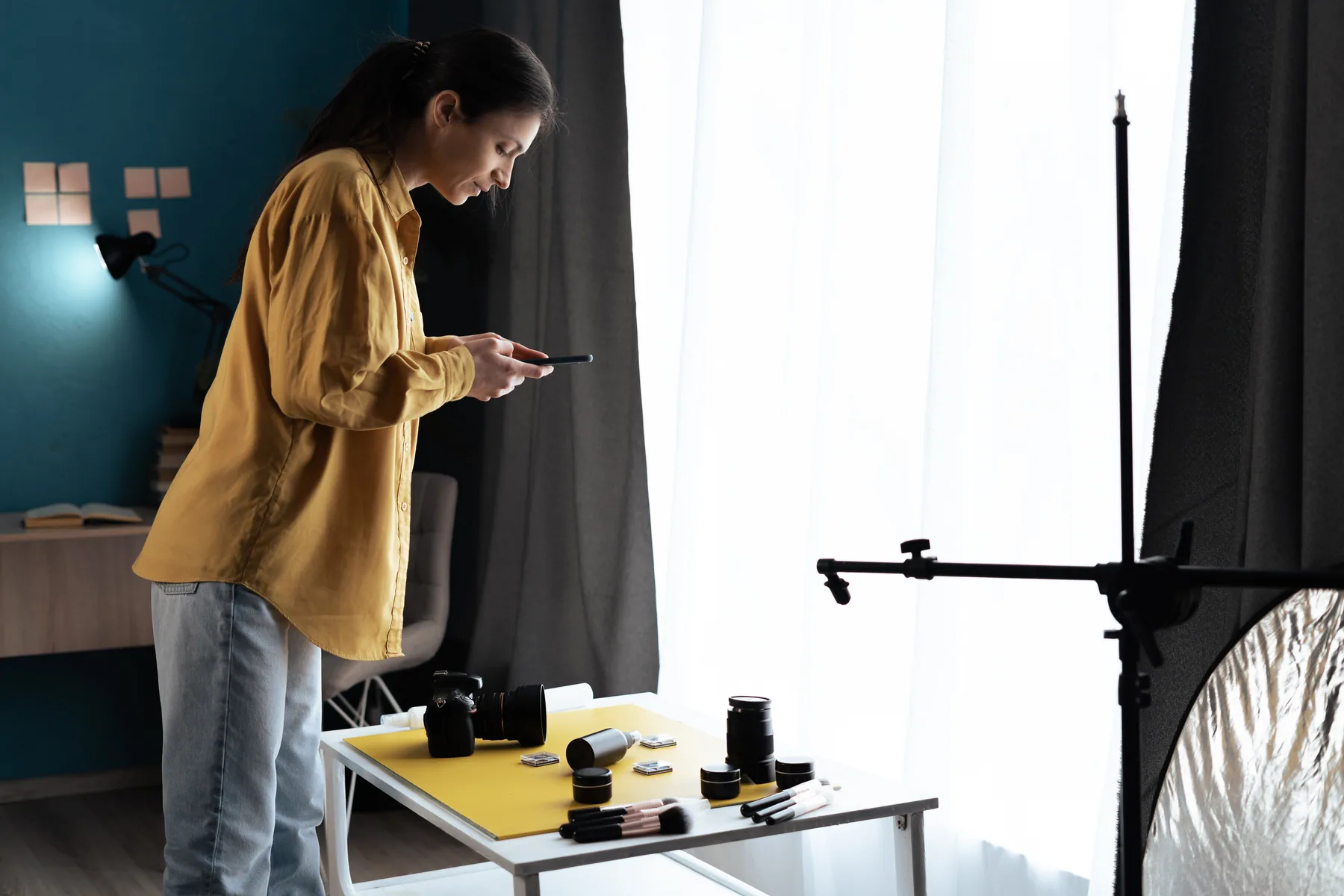
We sell product photography, so treat what follows with appropriate suspicion. But the honest position is this: for a lot of products, a recent phone is genuinely good enough for the main image, and telling you otherwise would be a lie you could check.
What a phone will not do is rescue bad light, a creased backdrop or a lazy angle. Those are the actual failures, and they are all free to fix.
What the main image has to be
Before technique, the rules, because a beautiful non-compliant image is worthless:
- Pure white background — RGB 255, 255, 255.
- The product fills most of the frame. Amazon's guidance is at least 85%.
- No text, no logos, no watermarks, no borders, no props. The main image is the product and nothing else.
- The actual product, not a render or an illustration.
- Large enough to zoom. Sources disagree on the exact threshold, so shoot 2000px on the long edge and the question stops mattering.
The setup that costs nothing
Window light, not your ceiling light. A north-facing window on an overcast day is a large soft source and it is free. Ceiling lights are small, hard, usually yellow, and they produce the harsh shadow that makes a product look cheap.
Turn the room lights off. Mixing daylight and tungsten gives you two colour temperatures in one frame and a white balance you cannot fix cleanly.
A sweep, not a corner. A sheet of white card curved from the table up a wall, so there is no visible line behind the product. A creased sheet of A4 with a horizon across it reads as amateur instantly.
Something white to bounce. A second sheet of card opposite the window, angled to throw light back into the shadow side. This one change does more than any lens.
Brace the phone. A tripod if you have one, a stack of books if you do not. Handheld at low light gives you softness you will not notice until you zoom.
Shooting
Get the phone level with the product, not looking down at it. Shooting down is the single most common phone-photography mistake and it makes everything look small and slightly sad.
Use the 2x or 3x lens if the phone has one. The ultra-wide distorts, and distortion on a product shot reads as a fake.
Lock exposure and focus by tapping and holding, then shoot several frames. Auto exposure drifting between frames makes a gallery that does not match.
Shoot more angles than you need, including the back, the base and any texture. You will want them for the rest of the gallery and re-staging later is a waste of an afternoon.
Where phone shots actually fall down
Two places, and neither is resolution.
Glass, gloss and metal. Reflective surfaces need controlled light and often several exposures composited. A phone in a window will show you the window, the room and you, reflected in the product. This is where a studio earns its fee.
The cut-out. Getting to true 255-white usually means removing the background, and automatic removers eat glass edges, hair, mesh and soft shadow. At full size the damage is invisible. At the size search actually renders your image, a bad cut is what makes a good product look like a drop-ship.
That second one is worth dwelling on. The test is not how the image looks on your monitor at full size. It is how it looks at about 180 pixels on a phone in a row of six competitors. Most images that fail, fail there — and you cannot see it while you are editing.
The honest recommendation
Shoot your own main image on a phone if the product is matte, simple and not glass. Spend the money instead on the images that carry the argument — the scale shot, the in-use shot, the what's-in-the-box shot — because those are the ones that prevent returns and answer the questions your reviews are currently answering for you.
If the product is reflective, or the cut-out is going to be fiddly, that is the point where doing it yourself stops saving money.
The service behind this
Amazon Product Photography
Ship us the product and we'll shoot it properly. Get the best possible results for your Amazon listing without renting a studio or briefing a photographer who has never seen an Amazon guideline.
See how we do it